SONIC PICO PARK level solutions follow the same order every time: take the keys, solve the stage's gimmick with your teammates as equipment, then get everyone onto the goal plate on the right. Most stalled groups are not solving a puzzle badly — they are solving it out of order.
SONIC PICO PARK level solutions: the order that works
- Collect the keys. A player picks up a stage key, and the key opens a keyhole in a wall, which opens the path onward. Take every key before pushing forward; a missing key means a dead end later.
- Clear the gimmick. Each stage has one theme, and it is usually solved by treating a teammate as equipment rather than by moving faster. Work the pattern list further down and check which one applies.
- Get every player onto the goal plate. The plate is the spinning sign on a post at the right edge. One player on it is not a clear, the camera will not scroll until everyone has moved on, and the stage ends only when the last teammate is standing there.
- Restart cleanly on failure. If anyone dies, the team restarts the stage or its last checkpoint — so keep the group together rather than letting one player rush ahead alone.
The boss stages break this pattern in one way: there is no checkpoint to fall back on, so a single death wipes the group. The boss guide lists the four encounters and what they do to a team.
Treat your teammates as equipment
This is the core of the game, and the same handful of patterns cover most of the campaign:
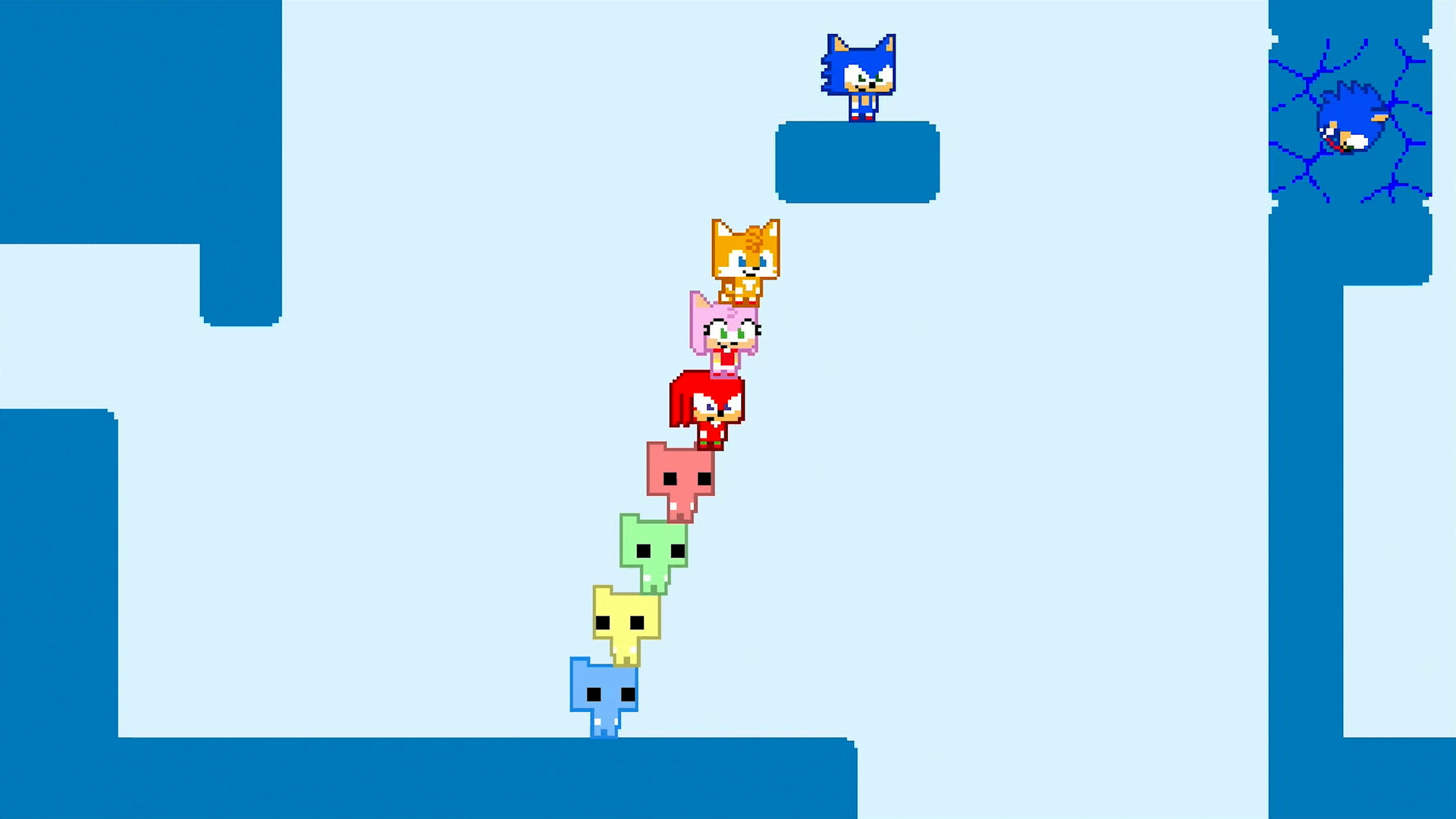
- Stacking. Players pile on top of one another to form a ladder so a teammate can reach a platform that is otherwise out of reach.
- Switches. One player stands on a button switch while another crosses, and some stages need several players on switches at the same moment.
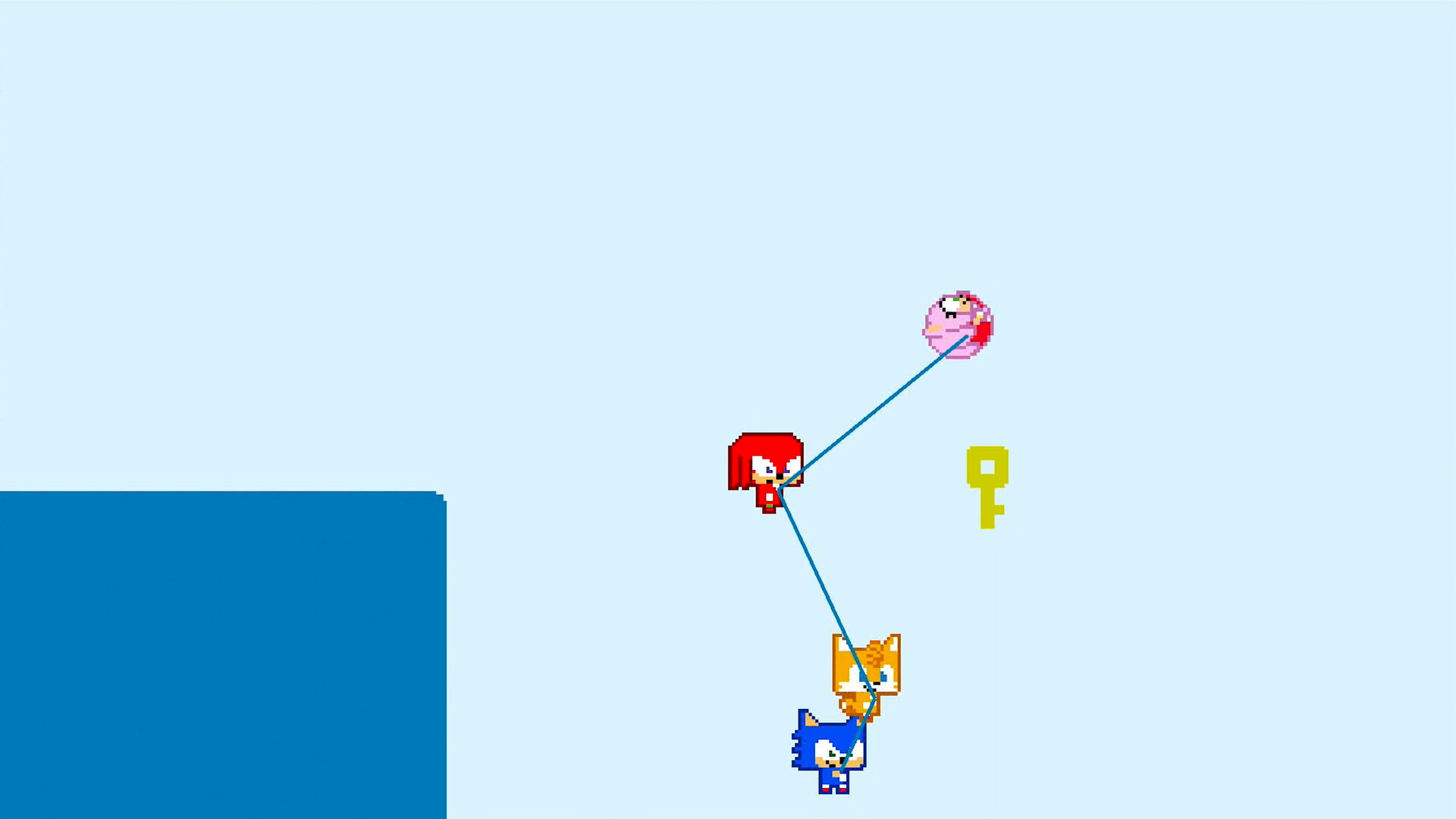
- Bungee cord stages. Everyone is tied to the same cord, and the solution is to dangle one player off the edge so they can reach a floating key over a pit.
- Carrying. One character carries another — Tails can lift a teammate over a gap, and WORLD 4 has two characters hauling a long beam while hanging from a hook.
- A teammate as a wall. One player sits in a hole in a curved path so another can Spin Dash up the curve and use them as a platform.
- Large characters as counterweight. Big the Cat, E-123 Omega and Vector the Crocodile can act as a heavy counterweight or extra wall space, at the risk of crushing a smaller teammate and resetting the stage.
Spend rings like a shared budget
A ring is a one-hit shield, not a score, and the later worlds make the team budget them deliberately:
- If a puzzle needs several players to take a hit, make sure everyone has a ring before anyone tries.
- In a stage with only one ring, one player has to deliberately step into a hit with it, letting the ring scatter to clear an unavoidable spike hazard for the rest of the group.
- Where several rings sit next to a descending laser, hand them out so each character can survive a hit.
- A character holding too many rings can be Spin Dashed into, so they drop them and the group redistributes them.
The rings guide covers the shield mechanic in full, including how a ring can be spent on purpose to clear an obstacle.
Use the right character, and swap if you have to
Character abilities are the puzzle tools, not decoration:
- Tails flies and can carry another character underneath him.
- Knuckles glides over large gaps to hit switches that clear the way for everyone else.
- Cream, Rouge and Charmy can fly as well, and one puzzle genuinely cannot be passed without a flier.
- Silver manipulates objects and lifts teammates.
- Big the Cat, Omega and Vector smash blocks and act as extra wall space.
If your party has nobody who can do what the stage needs, the game provides a dressing room between stages where you swap characters, and some stages put a character-swapping door inside the stage so you can hot-swap mid-puzzle. The character ability guide has the full list of who can do what.
Stage patterns you will meet
- Bungee cord stages — dangle one player off the edge to grab a floating key.
- Chao escort stages — a Chao has to be led all the way to the end of the level.
- Stacking stages — build a ladder out of your teammates.
- Pinball stage — the players each work a separate flipper on a Sonic 2 style pinball table while the balls fall into the void.
- Blue and red sphere stage — a round based on the Blue Sphere minigame.
- Grinding stage — a stage built around grinding.
- A slow-movement puzzle — the opposite of normal Sonic instinct.
- A four-player puzzle — crossing a large gap under a low ceiling, so nobody can fly over it, while hitting two switches at the same time.
- The rope-and-key puzzle — the team is tied together with a rope and has to reach a key: the two ends Spin Dash in opposite directions at the same time and use the rope's tension, or one player climbs to the platform above the key and hangs the other two vertically so the key can be taken.
- Momentum sections — keep moving in the same direction to build enough speed to dash along the ground, climb curved walls and pass through 360-degree loops, and where a wall is too solid for one player, several players Spin Dash into it together.
When you keep failing
The game helps in stages rather than punishing you: longer stages have checkpoints, and after enough failed attempts it starts giving hints — clue text written on the stage walls, and sometimes an extra ring to help the party through. Underwater stages add the classic countdown timer, so a ring that saves a hit still costs you time.