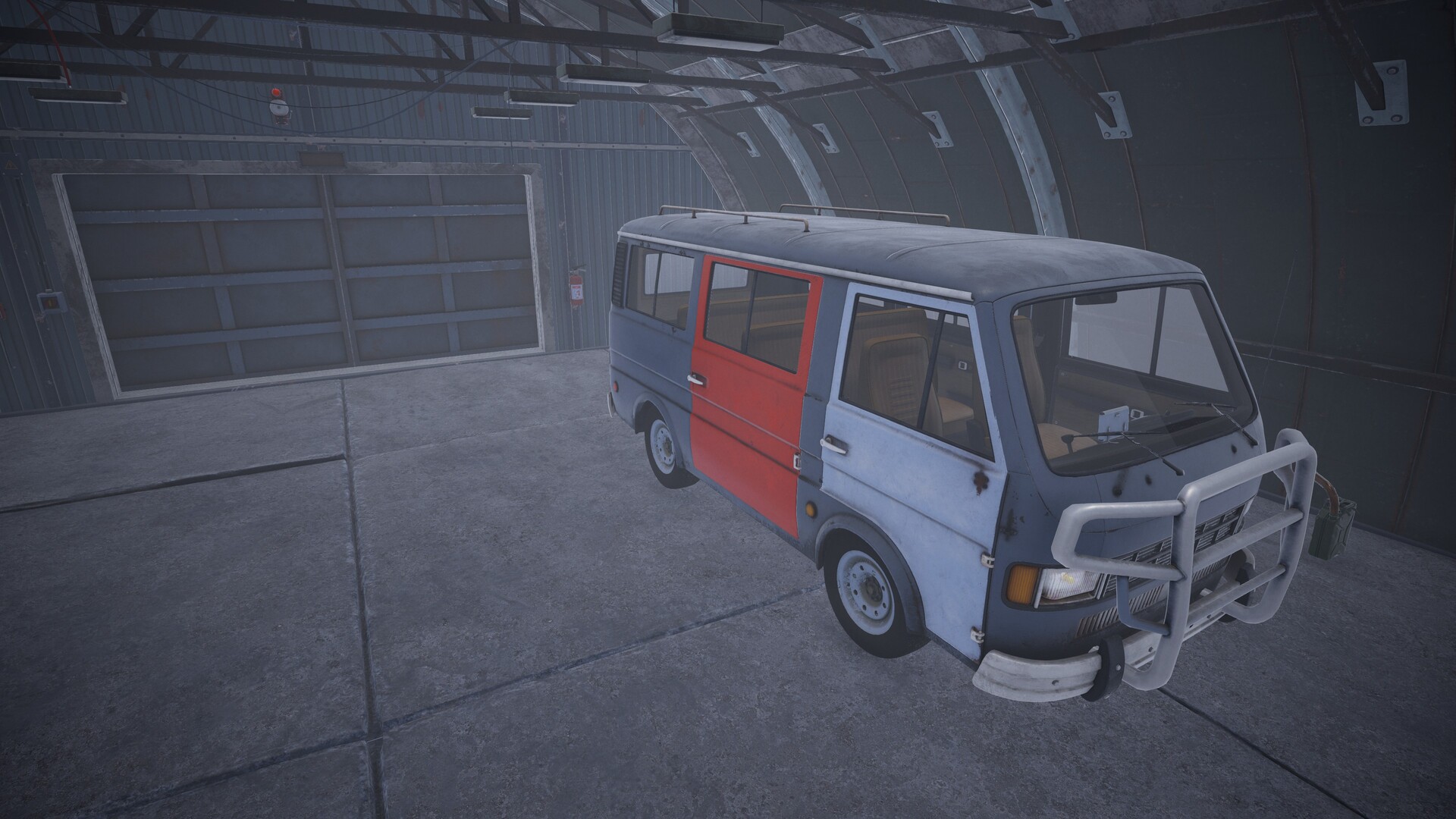
Your Arctic Drive starting car is a beat-up Facia Reno 12-4S with its 4-cylinder engine from 1978 — the car has been sitting in the garage of the cabin you wake up in, with its parts lying around it. It was set as the starting car in the v0.11.12 patch in August 2026, and its engine, the Old Car Engine, is the first upgrade decision you face.
Arctic drive starting car: what you wake up to
You wake up one morning in your cabin. There is no food anymore except a half-empty can of soda in the fridge, there is a beaten-up old car in the garage with all its parts lying around it, and the cold is wrapping around you. You have to get the car running quickly and leave the warmth of your home, because there is no way out but the long road into the unknown.
That is the starting position, not a tutorial: the car is a wreck, the world is a road with nothing on it, and the first job is to make the vehicle move again. The starting garage itself has been tuned over time so that the first few minutes are workable rather than empty.
The Facia Reno 12-4S and its Old Car Engine
The engine on the starting car is the Old Car Engine, and its tooltip reads: "This is a classic 4-inline engine which is very durable yet not the most fuel efficient and easily overheats. Needs a battery to start." The full stat block is:
| Stat | Old Car Engine |
|---|---|
| Peak torque | 182 Nm |
| Fuel efficiency | 0.6 km/l |
| Battery start cost | 0 units |
| Battery charge rate | 1 unit/s |
| Heat gain | 0.5 °C/s |
| Working temperature range | 0.0–135.0 °C |
| Oil capacity | 5 L of 6 L |
| Crafting cost | 500 workbench points |
| Weight | 105 kg |
| Quality | 3 stars |
Read that as a car that will start every time and pull hard, but that drinks fuel, runs hot and needs a battery to turn over. The 0 units of battery start cost means the engine does not need a charge to fire, while the 1 unit per second charge rate is what it draws while it runs. For the rest of the roster, and the trade-offs between the vehicles you can move into, see the vehicle roster guide.
What your starting garage already contains
The garage is not bare. Demo builds put a spare car radiator at the spawn point, and revival kits sit in the starting garage for groups of 2, 3 and 4 players. One of the Warden pickup's car doors was fixed, and the starting area was given fences so that players do not miss the road on the way out. Starting loot is also adjusted based on the player count, and the starting car, the pickup cars and several points of interest all received fixes in the same patch.
Take the radiator and the kits before you leave. Both are the kind of thing that decides whether a run ends on the ice.
When to trade the starting car for something else
The garage is the progression hub: the developers' roadmap describes claiming and rebuilding a garage full of vehicles, keeping them running with the new crafting system, and never losing a run thanks to saving and loading. The Reno 12-4S is a starting point, not a destination — the pickup, the compact N100 cars and the trailers each fix a different problem once you can afford them.
The order that works is usually this: make the starting car reliable first, because every other plan depends on it still moving. That means the parts listed in the vehicle upgrades guide, and the bench work to build them.