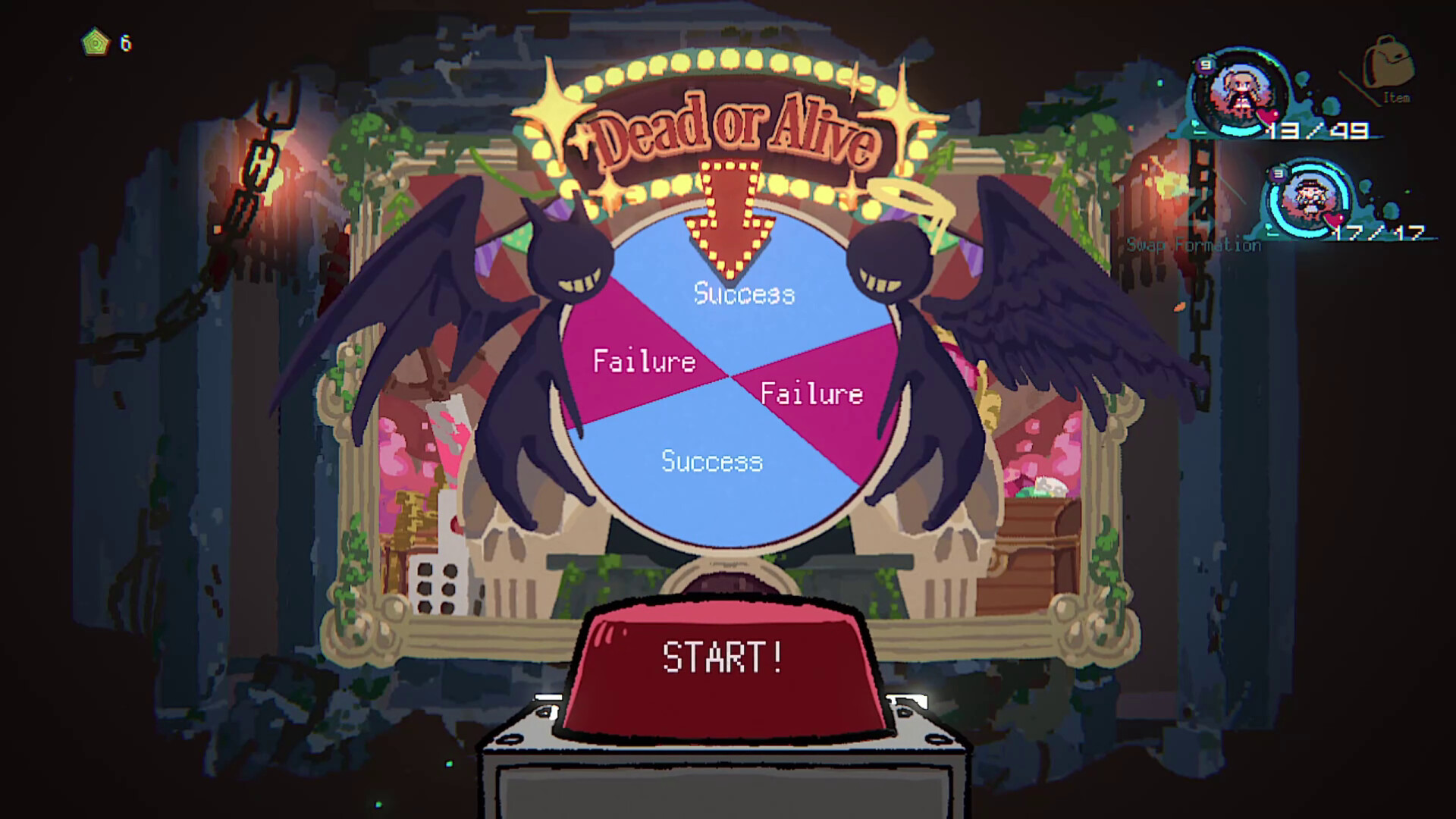
Annihilated timing battle vs probability battle comes down to what each interface asks of you: the timing-based style wants you to stop a cursor inside a marked zone on a horizontal bar, and the probability-based style wants you to take a spin of the Dead or Alive wheel. Neither one is a separate mode, and either one can carry a run all the way to the ending.
Annihilated timing battle vs probability battle, compared
| Timing-based | Probability-based | |
|---|---|---|
| What you see | A "PREVIEW" banner over a horizontal timing bar with a marked zone | A wheel titled "Dead or Alive" whose face is divided into Success and Failure segments |
| What you do | Hold the cursor in the right part of the bar | Press START and take the roll the wheel gives you |
| Where it shows up | The Goblin and Kobold fight, and again during the Outcast fight | During the Outcast fight, where the enemy's attack is flagged "CHANCE" next to its damage numbers |
The timing-based style
The timing form is the one with the "PREVIEW" banner and a horizontal bar with a marked zone above the field, and you stop the cursor in that zone to land the hit. It is on screen during the Goblin and Kobold fight, and again during the Outcast fight.
This is the style where your stats pay off most directly: higher AGI and DEX improve timed hit success rates. What each of those numbers changes is in the AGI, DEX and STR guide.
The probability-based style
The probability form is a wheel titled "Dead or Alive", its face divided into Success and Failure segments, spun with a large START button. During the Outcast fight the enemy's attack is flagged "CHANCE" next to its damage numbers, and the wheel resolves on the roll.
Here your input is the decision to commit and the read of the odds on the wheel's face — the timing bar is simply not on screen.
Which style a fight uses
The demo contains both, and it contains both inside the same fight: the timing bar shows up during the Goblin and Kobold fight and again during the Outcast fight, and the Dead or Alive wheel resolves during the Outcast fight too. So a fight is not locked to one style for the whole run, and switching styles is not something you choose at a menu.
The interface that opens when the exchange starts is your cue: a bar to line up, or a wheel to spin.
What both styles have in common
Both styles sit inside the same turn-based card loop. Your hand is your inventory, the enemy shows you its next move before it acts, and a card's remaining uses decide how many more attacks that card can give you. The card battle guide covers that loop turn by turn.