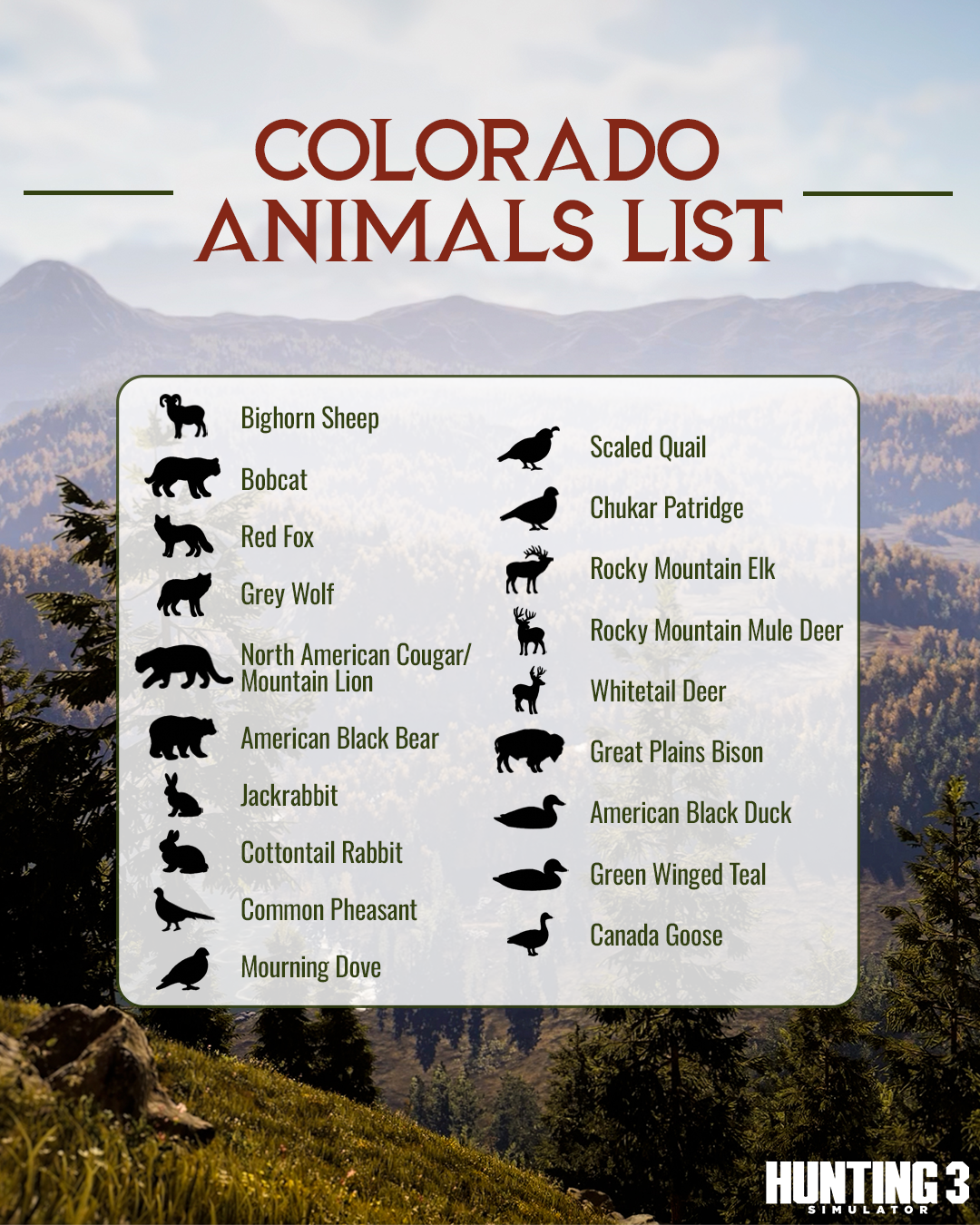
Colorado holds 19 animal species, and the developer published the whole roster before launch rather than drip-feeding it. The reserve covers roughly 100 km² and runs from high peaks through forest down to open prairie, so the list is really a map in disguise — the roster is split by where each animal works.
Hunting Simulator 3 Colorado animals: the full 19-species roster
- Bighorn Sheep
- Bobcat
- Red Fox
- Grey Wolf
- North American Cougar (Mountain Lion)
- American Black Bear
- Jackrabbit
- Cottontail Rabbit
- Common Pheasant
- Mourning Dove
- Scaled Quail
- Chukar Partridge
- Rocky Mountain Elk
- Rocky Mountain Mule Deer
- Whitetail Deer
- Great Plains Bison
- American Black Duck
- Green Winged Teal
- Canada Goose
Jackrabbit also appears on the Texas roster, and the pheasant on the Texas side is the same bird listed there as Pheasant.
The predators and the big game
Five of the nineteen are predators: the American Black Bear and the North American Cougar are the heavyweights, with the Grey Wolf and the Red Fox behind them and the Bobcat working the edges of cover. The black bear and the cougar are the two animals in Colorado that will treat you as prey rather than ignore you, and both of them also happen to be the ones with the strictest caliber rules in the game.
Three more are the big game you are actually here for: Rocky Mountain Elk, Great Plains Bison and Bighorn Sheep. The elk and the bison are the two animals that hold big groups — around 40 bison in the southern part of the reserve and elk herds of ten to twelve — which makes them the easiest animals to find and the most likely to put you in front of a wall of eyes when you do.
Deer, rabbits and the other small game
Two deer entries sit apart from each other and are worth telling apart in the field: Rocky Mountain Mule Deer and Whitetail Deer are separate species with different body types and different antler shapes, not two names for the same animal. The full release also gave elk, whitetail and mule deer a completely new set of antlers, so the shapes you remember from the demo are not the shapes you will see.
Below them sit the two rabbits, the Jackrabbit and the Cottontail Rabbit, which are the small game you will shoot most often while learning a new map. The Bobcat is also classed with the small predators that make small-game hunting dangerous rather than easy.
Upland birds and waterfowl
Four upland birds make up the rest of the bird life: the Common Pheasant, Mourning Dove, Scaled Quail and Chukar Partridge. Three waterfowl round out the list — the American Black Duck, Green Winged Teal and Canada Goose — and these are the birds that come in sizeable flocks.
Birds are dense, respawn quickly and sit close to the camera, which makes them the fastest way to earn money and Field Points on a first reserve. Once you have taken a species, its schedule and its hunting wiki entry fill in, and bird hunting gets a lot more precise.
Where these animals fit on the Colorado map
The reserve is built from seven biomes, and the roster maps straight onto them. Elk, mule deer and bison hold the open grassland and shrubland where you can see them coming, while the black bear, grey wolf, cougar and red fox work the timber, where sightlines are short and your noise carries. The Colorado map guide walks through each biome and what it means for an approach.
Once you have an animal in front of you, the age and DNA readouts on the harvest screen decide what it is worth, and the trophy scoring guide explains how to read them.