UNDERDEEP cartography is automatic: every tile you walk onto is drawn onto the dungeon grid as you explore, so you never draw anything by hand. Coverage, not kill count, is the number that decides how far you get on each run, and the dungeon layouts themselves are fixed, with the randomness living in the spawns.
Underdeep cartography: how the map records itself
Every tile your character walks is recorded onto the dungeon grid, and exploration is what fills in the chart. On top of the recorded tiles you can drop your own markers on any tile to remember places: the map panel has marker slots labelled A through L plus a Delete button. Those markers are not decorative - they drive how your character behaves during auto-play.
The six dungeons on the list
The dungeon list on the left of the screen shows all six dungeons, each with a Coverage percentage and an Explore button that sends you back into it:
- Dungeon of Gold (Upper)
- Dungeon of Gold (Mid)
- Dungeon of Gold (Lower)
- Arcane Mine (Upper)
- Arcane Mine (Mid)
- Arcane Mine (Lower)
Coverage is the percentage of a dungeon's tiles you have revealed.
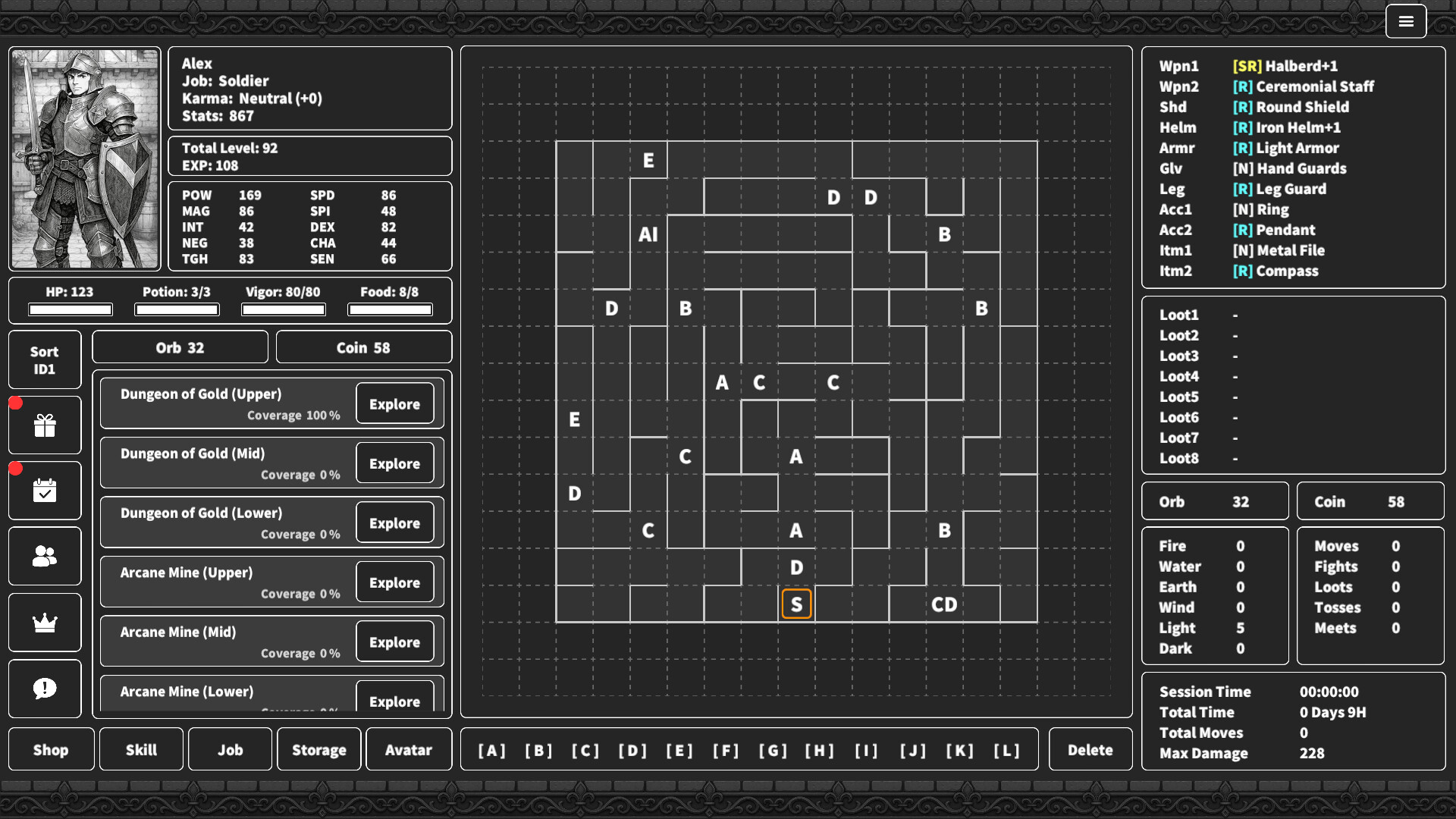
Coverage is the real completion stat
Coverage is not just a completion percentage: it is the source of your Vigor and Food budgets, so revealing new tiles is literally what makes your runs longer. The summary window at the end of a run states the coverage percentage at which the next increase will come, so the game always shows you the next goal. The vigor and food guide has the numbers behind that.
Coordinates are why maps are shareable
The grid is addressed by X,Y tile coordinates starting at 0,0, and that is what makes a dungeon map worth sharing: you can tell another player that a mimic sits at a specific coordinate, or that one route is the fastest. The first dungeon has a known, repeatable path through those coordinates, which the Dungeon of Gold guide walks through step by step.
Layouts are fixed, spawns are not
The dungeon layouts are not procedurally generated. They are fixed, and the reason given is exactly that shared information: knowing that something was at these coordinates, or that this route is the most efficient, is only useful if the layout stays the same.
Think of a dungeon as a network rooted at the starting tile. Every leaf or end point is a fixed encounter, while all the other tiles roll random spawns - and once you have cleared an end point, it becomes random too. Enemy level tends to be fixed for a given tile. That is why the game plays as a learning-then-optimising loop: your first runs reveal the map and find the good encounters, and after that the game is picking the most efficient farming route for the tile band you can reliably one-shot. New dungeons are on the development roadmap, so the list of six is not final.
Dropping your own markers
Your custom markers are what turn a recorded map into a route your character can run on its own, and the policy each marker carries decides what happens on that tile. The route settings guide covers the letters, the repeat key and the fallback behaviour.