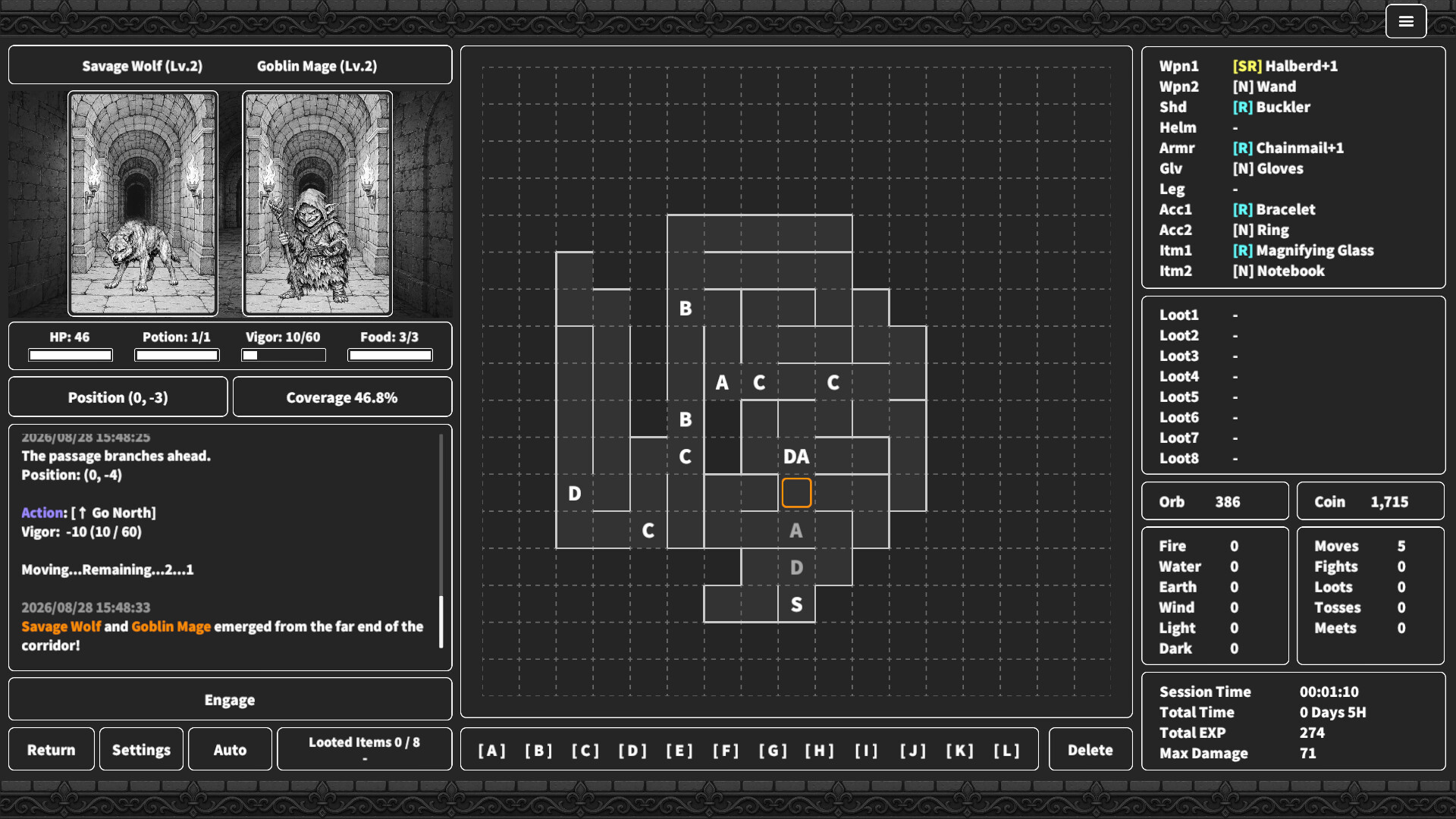
The UNDERDEEP movement timer is a 3-2-1 countdown before every action resolves, on top of text that types itself out word by word, so a single step really takes around four to five seconds. That is the reason a 72-tile route takes exactly 16 minutes.
Underdeep movement timer: every step waits on a 3-2-1 countdown
Every action is gated by the countdown before the next step resolves, whether you are moving to the next tile or confirming a decision. On top of that the text types itself out word by word, and those two together are where the four to five seconds per step go.
The delay is the most complained-about part of the game. Players ask for the text to be instant instead of word by word, for the countdown to be removed or shortened during manual play, and for movement between tiles to be quicker. The development roadmap lists an adjustable command confirmation delay during auto exploration of 1 to 3 seconds, so the current fixed countdown is expected to become configurable.
Three ways to move
- The four direction buttons under the map (Go North, Go West, Go South, Go East). These are the same four directions as the A, B, C and D auto-explore markers.
- Clicking a tile on the map grid, which moves the character there directly.
- Dragging or swiping across the map, which moves the character much faster and feels like a mobile game. This is the fastest way to travel manually.
The map itself records every tile you walk onto, so manual travel is also how you fill in the chart - the cartography guide covers what that coverage is worth.
Auto-play is the fourth way
Auto-explore is scripted with the A/B/C/D markers under the map, and it follows the behaviour policies assigned to each tile. It is the option that turns a route into unattended progress, and the policy list is in the route settings guide.
There is no keyboard movement
The arrow keys and WASD are not supported, and players have repeatedly asked for them. The first-time experience is clicking with the mouse, and after that the markers let the character act on its own while you watch.
Why shorter routes win
Since every step costs the same wall-clock time, a shorter route is always worth more than a fuller one. That is why route design in this game is mostly about reaching the good tiles in the fewest steps, and why a route that is short by design can be repeated forever.