A Clean Start dialogue choice is a numbered reply at the bottom of a full-screen conversation, and every conversation ends the same way: the client speaks, you pick a line, and the scene ends. What makes the choices meaningful is the language mechanic — Lena does not speak the client's language, so a reply is often a decision about whether to pretend you understood.
Clean Start dialogue choices guide: how a conversation is structured
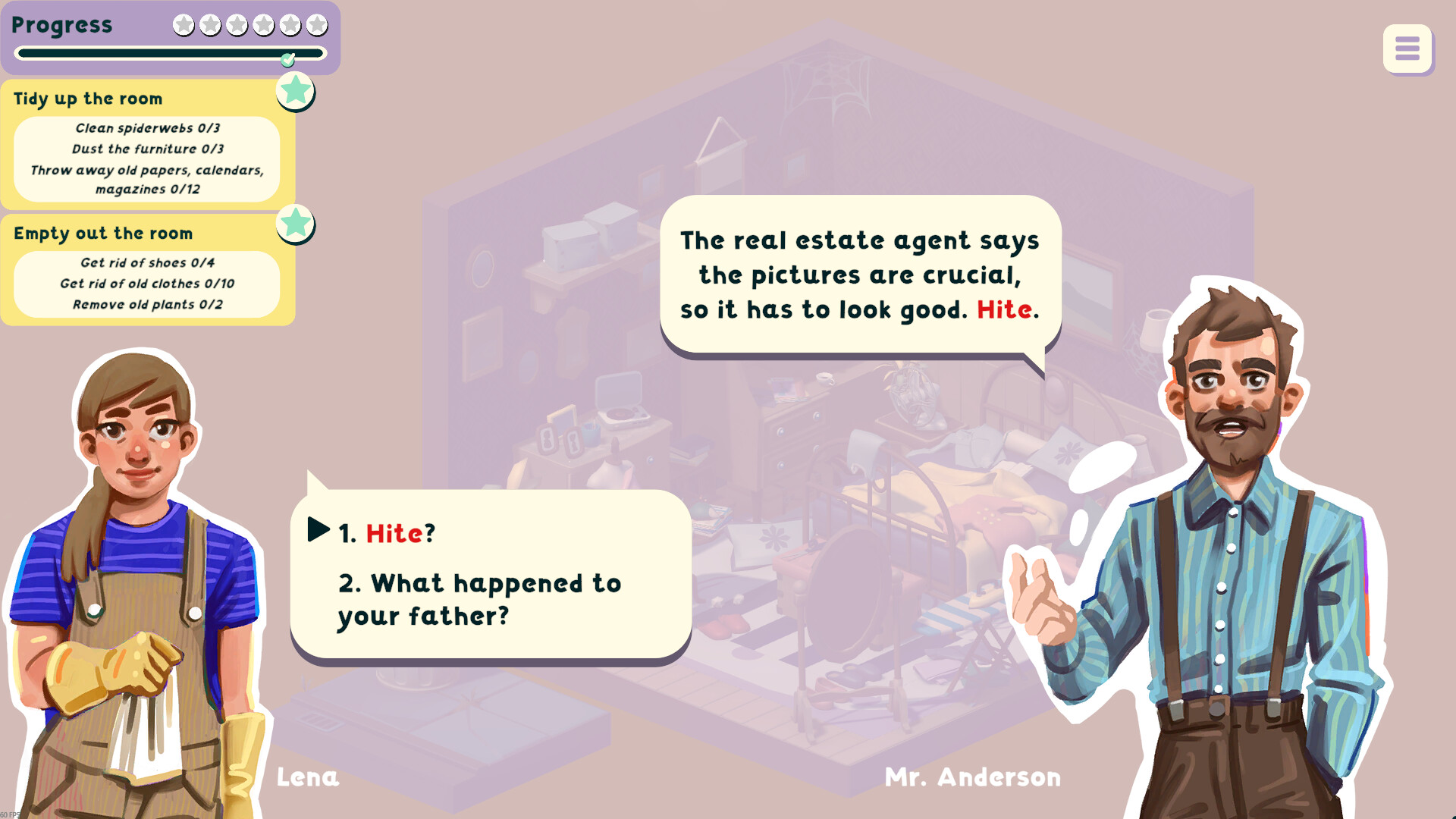
- The client speaks in a bubble at the top, in front of the faded room.
- You answer from a numbered list of replies underneath, with a marker on the option currently selected.
- There is always a bare '…' option that says nothing, so you can let a silence pass.
The choices are built around the language mechanic, because Lena does not speak the client's language:
- With Mariko the client opens with 'Er, sorry? I don't speak your language.' and the two options are '(How was it… I know!) Bless you!' and '…'. Pretending to understand and admitting that you do not are both valid ways through the same conversation.
- With Mr. Anderson the client ends a line with the unknown word 'Hite', printed in red like every word Lena has not understood yet, and the options are 'Hite?' and 'What happened to your father?'
- In the living-room level the client asks 'And how about you, Lena? What's your passion?' and Lena has to answer for herself: 'Plants. I love gardening.' or 'Books. I always loved reading.' The answer is about Lena, not about the room.
Once the scene ends there is no way back into it, and the conversation log guide covers what the game does and does not keep for you.
What your answers actually change
The choices are not decoration. The store page states that your conversations with your employers — and the gifts they give you — vary depending on what you discover in each level. The more you find in a room, the more the client has to say to you, and the more it changes what you get afterwards.
Some dialogue also carries the job itself. In the living-room level the client's request mentions that the child's things should be put aside without saying where they go, which is exactly why the task list and the hint button matter in that level.
The reward side of that chain is on the client gifts guide, including the one limit that decides how much of a room's story you can hand over at once.