Oboro no Ichi how to expand your market works by fitting more into the ground you already have: the plot is ringed by forest and water, so growth comes from linking production chains together, opening new areas and routing paths more efficiently rather than from clearing space.
Oboro no Ichi how to expand your market without a bulldozer
Expansion in this market is incremental. You link production chains together and open new areas so the market can evolve in gentle stages, adding new facilities, areas, structures and decorations over time rather than all at once.
The build loop stays the same at every stage of the growth: place roads, resource buildings, market stalls and decorations, then press Open Market at the top of the screen so wandering spirits come in as customers. Stalls, buildings and pathways have to be connected for the market to work, so every expansion is really a question of where the next chain links into the existing network.
Growing inside a bounded plot
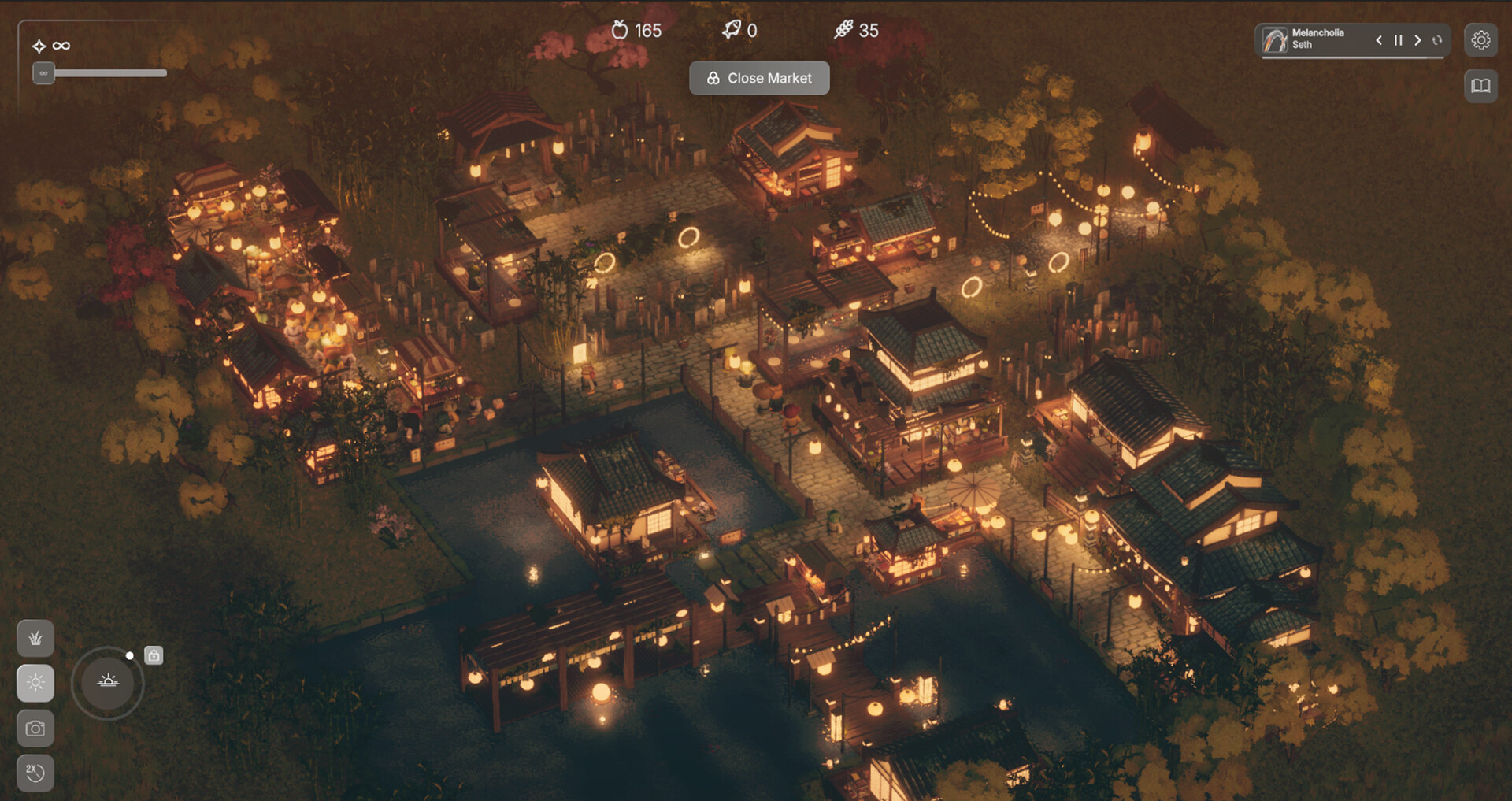
The market occupies a bounded plot, ringed by forest and water. Growing it means fitting more structures and paths into the space available, and since there is no bulldoze tool and no terrain reset, the gaps you close are gaps you cannot reopen.
Layout is the main lever you control. Stall placement, path routing and structure priority affect how goods flow and how efficient the market is, and those same choices set the market's atmosphere and appeal — appeal is what draws more spirits. The design is freeform and intentional: the same layout has to look good and function well at the same time, which is what market layout tips works through.
What the demo lets you build freely
In the demo, expansion is unbounded. The money counter shows an infinity symbol in free build mode, so you can place as much as the open space allows without earning anything, and stalls in free build do not require upgrades. What the demo does not give you is the content: its selection of buildings, decorations and progression is smaller than the full game's.
That makes the free demo the right place to test how far a layout can be pushed before it stops working, and the full game the place to find out how much it costs.
What Early Access adds
In the full game the same layout loop applies, and the Early Access roadmap adds new items and structures, richer market-customisation options, deeper events during market hours and more market content and systems. The developer also notes that the full game already carries more living and interactive elements than the demo.
Area unlock conditions, area sizes, expansion thresholds and build costs for the full game are not published yet, so the practical answer for now is that expansion is driven by layout quality and appeal rather than by a spendable unlock. Turning that appeal into visitors is what attracting more spirits is about.