County of Fortune production chains turn raw materials into finished goods, and each settlement specialises in what its surroundings provide. The clearest chain in the game is construction: logs become carpentry points and stone becomes masonry points.
County of Fortune production chains: the ones that matter first
| Raw material | Workshop | Output | What it is for |
|---|---|---|---|
| Logs (Logging Camp) | Carpenters' Guild | Carpentry points | Building and maintaining settlements, buildings and roads |
| Stone (Stone Quarry) | Masons' Guild | Masonry points | Mostly required for the Commoner tier of buildings |
| Logs | Wooden Chest Workshop | Wooden chests | Peasant equipment |
| Wool (Sheep Farm) | Wool Tunic Workshop | Wool tunics | Peasant equipment |
Other goods around the demo and Early Access map follow the same shape: clay into pottery, grain into flour into bread, milk into cheese, bees into wax for tier-2 needs and candles, and beer brewed for taverns. Bread is an ingredient in roughly half of the food recipes and raises the efficiency of level-2 production buildings; a tavern supplied with beer gives a 10% production bonus — shown in the tooltip as 110% entertainment — to itself and the nearest nearby villages.
If a chain is not working for your region, changing production covers replacing the building that starts it.
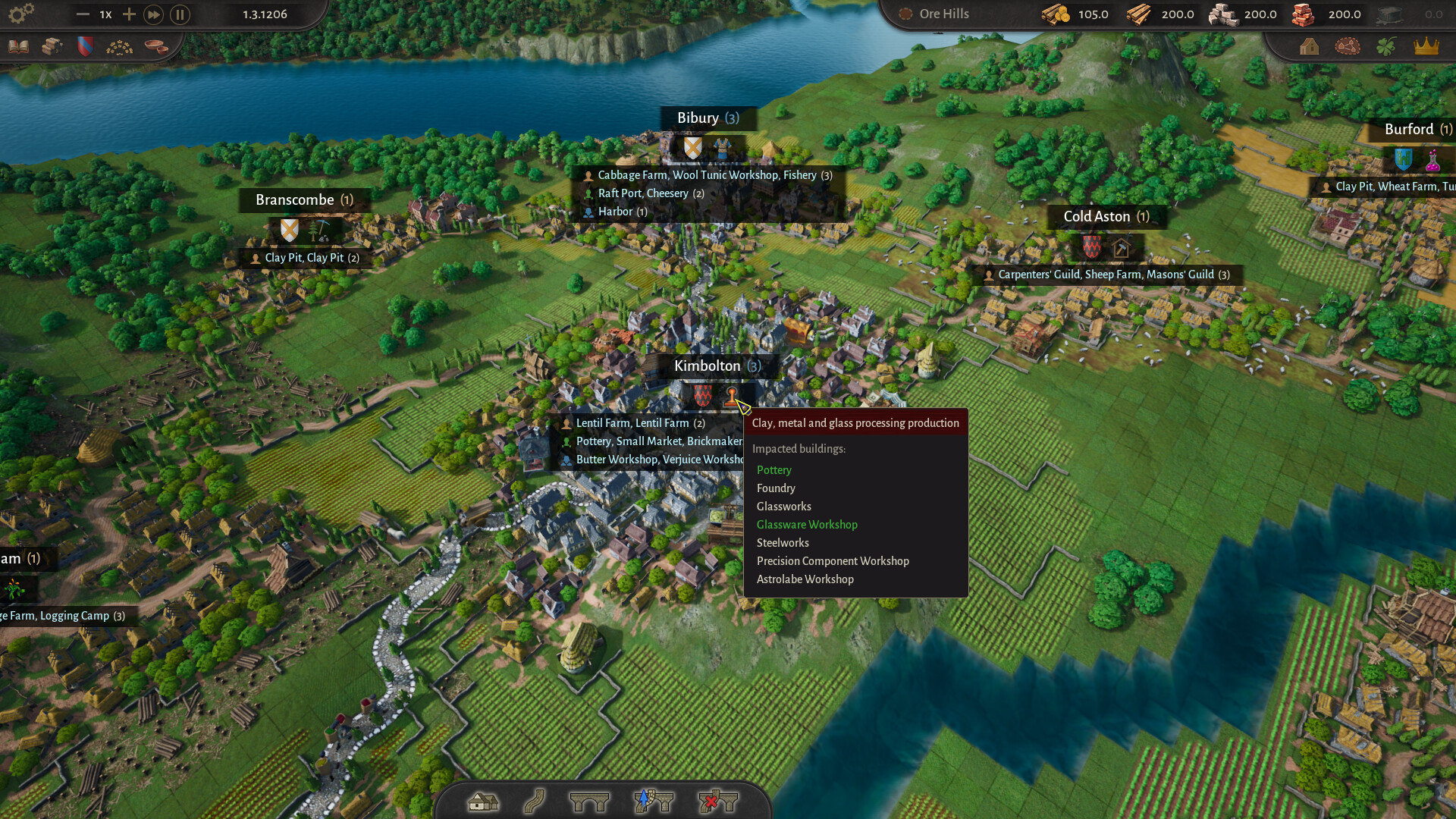
Some products are services, not goods
Carpentry and masonry points are services rather than goods. They need the workshop, the labour and the material in the same place, which is why they cannot be traded between regions — only the raw material can. Any region that wants tier-2 buildings therefore needs its own masons' guild and has to have the stone shipped in. Construction points covers how that works, and trading covers what can and cannot cross a region border.
Reading the map's resource colours
Resources are typed by colour on the map: yellow is sand, unused in the demo and planned for a glass production line; orange-ish is clay; grey can be stone or iron ore, with iron unused in the demo. Clicking a deposit shows what it is and what it produces, and a settlement only needs part of the deposit inside its area to unlock the matching production building. Where to build settlements covers the placement rules that decide which chain you can join.